
Why not?
For as long as I can remember, I was on a “quest.” I think a lot of people are, though the nature of the quest might vary from person to person, and what may be meaningful to one might seem frivolous to another. The content of the quest, I think, matters less than the energy it generates. For me, the quest was “spiritual,” although my definition of spirituality has changed over the years.
I was raised Catholic and attended twelve years of Catholic school. I remember that, as a kid, I had a “nun doll” and early on, I thought I’d become a nun—a very big door. But by the time I was sixteen, that was simply out of the question. Especially since I’d gotten thrown out of confession for questioning the infallibility of the Pope. But that’s another story.
Next up was transcendental meditation (TM)—meditation à la Maharishi Mahesh Yogi. I remember waitressing (we didn’t call it serving then) in Circles Cafe, a cool restaurant in Bay Ridge in the 70s, where most of us who worked there took “TM breaks.” So, when Maharishi appeared on the Merv Griffin show one night, we brought in a TV and watched to see if he would levitate. (He didn’t). Then it was Guru Maharaj Ji, the teenage guru, until his followers told a group of us, at the end of a long day of what, in retrospect, was brainwashing, that we had to clean toilets. I guess my ego was too big, so that was the end of that.
My searching didn’t stop there, though. I was on and off “the path” for many years, exploring various religions, philosophies, teachings, and practices. I took something away from almost all of them, and while there often wasn’t a specific thing that made me hold back, I never fully committed to any of them.
What was I looking for? I think I was looking for some deep energetic connection that I expected—but never found—in Catholicism, and that I could never sustain on any of the other paths I tried.
In the 70s, I was all about eastern philosophy and religion (though not so much about cleaning toilets). I majored in both Religion and Philosophy in college (and minored in Music), and my favorite and most influential undergraduate professor was George Elder,* who taught Religion (mostly eastern) from a Jungian perspective. He also referred me to the C.G. Jung Institute in NYC, where I found the Jungian therapist I worked with throughout my 20s. She was a godsend, and, throughout my life, Jungian psychology has deeply informed how I interpret the world. When I retired from teaching, I trained and became a Jungian coach, because it’s been looking through the Jungian lens that has helped me make meaning in my life, and I think it can help my clients find more meaning in theirs.
I’m mentioning all of this because in my 20s, I fantasized about going to India and living in an ashram. Every girl’s dream? Maybe not. But certainly mine. I’m sure the dream was also fueled by my reading and rereading W. Somerset Maugham’s The Razor’s Edge. Larry Darrell might be my favorite character of all time. (If you don’t know the story, choose the book over the movie versions of it. I could almost buy Tyrone Power as Larry in the 1946 film, but, much as I love Bill Murray in so many roles, he’s not my Larry.) What I loved about the character is that—spoiler alert!—he goes to India, becomes enlightened, and then goes back to America, planning to become an auto mechanic. My dream guy—an enlightened auto mechanic. I’m not kidding.
So, when I took a sabbatical from 2019 to 2020 (literally right before the pandemic), India was on my list of places to visit. Big door for me. I went to Tiruvannamalai and visited two ashrams there. One was the ashram of Yogi Ramsuratkumar, where I chanted at least once—and often twice—a day and got to know a number of people. The other was the ashram that Maugham visited in the 1930’s to meet Ramana Maharshi, an experience that, it’s been reported, inspired Maugham to write The Razor’s Edge (1944) in the first place. I visited that ashram only twice and didn’t really engage with anyone, but did get some materials on the teachings.
At the ashrams, though, I felt awkward and out of place. And chanting—a staple practice of Bhakti (devotional) Yoga that was practiced at the ashram of Yogi Ramsuratkumar—didn’t open my heart. I remember talking to the spiritual leader there, who had been yogi’s devotee when he was alive. She was saintly and picked up that I was not getting it. She tried to help, but I realized that the devotional path was not my path. So, my big door—going to an Indian ashram—hadn’t taken me where I thought it would.
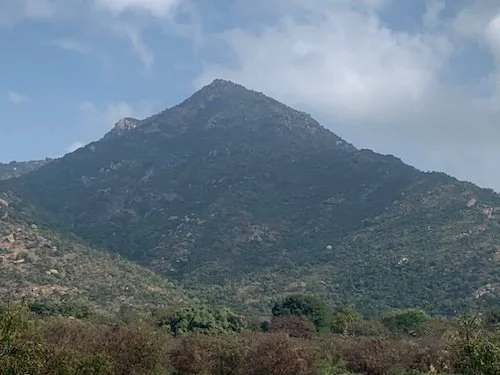
But I loved Tiruvannamalai. It’s a special place where I met so many warm and kind people. It’s situated next to a sacred hill called Arunachala and I was lucky to participate in Girivalam, a sacred circumambulation around it, which was exciting. Every day, for the almost four weeks I was there, I sat on the roof of the apartment building where I was staying, and meditated while watching the monkeys play, before an unobstructed view of Arunachala. That’s probably when I felt the most “spiritual.”
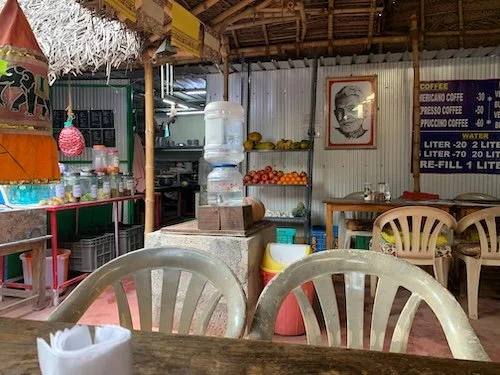
And almost every day, I went to a small family owned and operated restaurant. the Tasty Cafe. I think the family probably lived in the restaurant, too. The parents and older children cooked in the back and the twelve-year-old daughter, Nisha, was the server and cashier. She was a very pretty girl, and despite being only twelve, carried herself in a way that was more grown up. More knowing. And also, more distant. I noticed this because having waited tables for a long time (that’s what you get for majoring in Philosophy and Religion—though, actually, I loved it), I always talk to the server, and it took a while for her to warm up to me. Eventually she did, and she’d smile and say “hello” when I walked in.
One day, when she came over to take my order, I asked her, “How are you today?” She looked at me and said, “Fine.” And then she took a beat and added, “Why not?” with a little shrug of her shoulder. I’m not sure why her response struck me the way it did at just that moment, but it was the little door I needed.
That unusual pause and the addition of Why not? to fine in a common exchange of greeting felt profound—so much so, that I’m thinking and writing about it six years later. It hit me in a very deep, and not totally intellectual, way. My head and my heart opened up. Reflecting on it after the fact, it suggests two things: an acceptance of life just as it is and the recognition that how we feel is a choice.
The idea of acceptance is carried by both parts of Nisha’s response. Fine is an interesting adjective. When we talk about fine wine, for example, we are describing a wine that is “very good” or even” exceptional.” But often, and it seems to be the case here, fine means “acceptable.” Nisha’s not great—she’s fine.
The Why not? also suggests acceptance—surrender of control of this moment—since it’s impossible to change what’s here right now. You can make adjustments now to inspire change in the next moment, but you can’t change this one. And much pain comes from resisting what is. I remember getting a parking ticket and being so angry about it that I didn’t pay it and just left it on my desk. Every time I looked at it, I was annoyed. Then I realized that since I was in the wrong, I had to pay it either way, and that the sooner I paid it, the less it would annoy me. So now I accept parking tickets (if I’m guilty!) and pay them as soon as I get them. And life sometimes feels like a series of parking tickets.
Choice seems suggested by the Why not? and is empowering. Why not be fine? What’s the alternative? Terrible? Why choose that? And if having a fine day is a choice, making that choice every day, creates a fine life. The trick, it seems, is making that choice every day, day after day. Easier said than done.
One more note about Nisha’s response. I asked, “How are you today?” I didn’t ask about the day, or the weather (hot!) or about business in the restaurant. It occurs to me now that accepting what is and choosing to be fine suggests seeing ourselves as outside of our experience. Life may be great. Life may suck. But we are fine.
An 8,000-mile trip, two ashrams, weeks of chanting, and a walk around Arunachala. Yet it’s an offhand comment from a twelve-year-old server that moved me. Small door.
And I didn’t even have to clean the toilet. But I left her a good tip.
And you think she knows something by the second refill
You think she's enlightened as she totals your bill
You say, "Show me the way to Barangrill”
Joni Mitchell, “Barangrill,” For the Roses, 1972
*Do yourself a favor and follow the link to George Elder’s website. His blog is brilliant, and he offers insightful analyses of many current events from a Jungian perspective.
