
What’s so wrong about being wrong?
I attended a conference on teaching and learning in higher education about 20 years ago and saw a presentation that has stayed with me all these years. So yes…another small door. The audience were primarily middle-aged academics, and the speaker was a physics professor, Jose Mestre, who did a demonstration using games where balls “raced” on different tracks.
He showed us two tracks: Track A was shorter and basically flat; Track B was longer, and more like a roller coaster with an early, deep plunge. He asked us which track we thought would be faster, and by a show of hands, we guessed A, B, or a tie. I guessed A because it seemed more logical. He played a video of the race, and we saw that B won. He then explained the physics behind why Track B was faster. I honestly don’t know much about physics (not my best class in high school), so I had guessed wrong, but I understood his explanation.*
Here’s where it got interesting. He showed us a second set of tracks, C and D, that were not identical—but comparable—to A and B, respectively, and asked us the same question. We voted with a show of hands that looked an awful lot like the first one. He played the video of the second race, and Track D—comparable to Track B—was faster. Same result for the same reason. Despite his clear explanation after the first race, very few of us who were wrong the first time, including me, had changed our views.
We were given the information we needed to make the right choice—and still we ignored it. That’s mental rigidity. Hanging on to what we believe, a way of thinking, our stories—in spite of evidence to the contrary. Why did a group of middle-aged people (including me!) who worked in higher education—of all things—refuse to take in and apply new information—refuse to learn? Weren’t we supposed to be—literally—in the business of learning??
Mental rigidity is like building a wall around our beliefs, keeping out new information that might challenge our way of thinking, might show us that we’re wrong. So why do we resist being wrong? What’s so threatening about it?
I think we hang onto our stories because what we believe is often central to who we think we are—what Jung called our ego. So, when what we believe is shown to be wrong, who we are is also shown to be wrong. That can be really destabilizing, so we dig our heels in, and stick with what’s wrong.
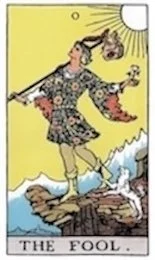
The Fool from the Rider-Waite Deck © Copyright U.S. Games Systems, Inc.
Not knowing anything about physics, I made my first guess at the presentation based on logic. It didn’t work and I was wrong. As a new professor, that was unnerving. So, when I was asked to make the second guess, I doubled down. It couldn’t be as easy as just applying the physics that had been explained to us. It had to be a trick question; we were being led down the garden path, and I was too clever for that! But I was wrong…again. So, not so clever after all.
This small door showed me my own mental rigidity, which seemed to be motivated by a need to see myself as “smart”—which creates a tendency to expect things to be harder than they are—and a fear of being “taken for a fool.” Lots of ego protection going on there. 🙄
Jung described the ego—who we think we are—as the center of consciousness. In addition to beliefs, the ego also includes the roles we play, our experiences, and our self-image. During the first half of life, we take on new roles, accumulate experiences, and develop beliefs and a self-image. Who are we when we commit to a life partner? When we embark on a career? When we have children?
If all goes well, somewhere in midlife, our lives and our egos might look relatively stable and if we identify with our egos (which most of us do), we think our identities are stable, too. But they’re not—because the beliefs, roles, experiences, and self-image that make up the ego are vulnerable to change. So, the questions in the second half of life may become: Who are we when a life partnership ends? When we lose our jobs or it’s time to retire? When our children no longer need us the way they used to?
And when multiple changes take place simultaneously—as they sometimes do in midlife—it feels like, well, a crisis. I know. I’ve been there. And more than once. We no longer feel like we’re on solid ground. We can feel unmoored because we’ve lost a frame for how we see ourselves and how we respond to and function in the world.
If we’re not responsible for the change that occurs because it’s something that’s out of our control—an illness, death, aging, children growing up—we might resist it, but we don’t blame ourselves for it.
However, sometimes—such as when a partner leaves or when we are “let go” or “retired” from a job—we may start to blame and question ourselves and our choices. Were we wrong? Did we choose the wrong partner, the wrong work, the wrong life? So, we resist to protect our egos.
It’s interesting that we might resist the change even if what’s changing is something that we experience as limiting, stressful, or soul-sucking. Why? Well, for one thing, it’s “the devil we know.” It may be horrible, but at least it’s familiar. The unknown could be worse.
In addition, if we do accept the loss of something that was awful, and things become better, how do we justify the years we spent being miserable? We realize we could have made the change a long time ago but didn’t. So now there’s regret for having suffered needlessly. Wrong again.
All of these midlife changes can feel threatening to our identity—if we identify with the ego. But Jung didn’t equate identity with ego. Jung distinguished between who we think we are, i.e., the ego, and who we are, which goes beyond the conscious ego to include the contents of the unconscious, both personal and collective. The contents of the personal unconscious include anything that belongs to an individual’s psychic history, but that the ego has forgotten, ignored, repressed, was never fully aware of, or rejected (the shadow).
The collective unconscious, on the other hand, is universal and contains what Jung calls archetypes—universal energetic structures or patterns. For example, we all share an image or concept of the energetic pattern “Mother”— unconditionally loving, nurturing, etc.—even if our personal mother was like Joan Crawford.
Though we’re not aware of what’s in the unconscious, it wields tremendous power over our lives—as long as its contents remain unconscious. As Jung said, “Until you make the unconscious conscious, it will run your life, and you will call it fate.” So, the work of the second half of life—what Jung called individuation—is to bring the unconscious material to consciousness. To know, accept, and integrate all of ourselves. To become whole. Authentic.
Changes in midlife, then, are doors to individuation. While they can be disturbing, they can also be seen as an invitation to what Joseph Campbell referred to as the hero’s journey—a story structure that we see over and over again in myths, legends, fairy tales, novels, and movies.
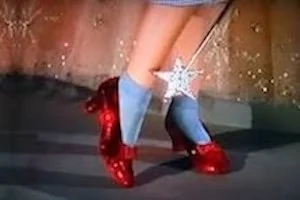
The journey starts with “a call to adventure” that takes an individual out of their comfort zone, through a road of trials, and into the “belly of the beast” where their deepest fears are faced and overcome. As a result, they receive a “boon”— a reward or blessing, often in the form of an insight. The individual then returns home and integrates the insight into their everyday life. Think Dorothy in the Wizard of Oz, who returned to Kansas with the insight that she always had the power—represented by the ruby slippers—to return home.**
So far, we’ve described the call to adventure of midlife as the external changes that no longer allow the status quo to be maintained. But the call can also originate internally, often experienced as a sense of dissatisfaction or absence of meaning that motivates us to initiate a change. And sometimes it can be both. In the Wizard of Oz, at least in the movie version, Dorothy expresses a longing to go “over the rainbow,” and it’s an outside force—a cyclone—that “sends” her there. The external world mirrors the internal. Jung had much to say about that, too. Synchronicity. ***
Whether the call is internal or external, we can’t take the journey unless we are willing to be wrong—wrong about identifying with our ego, wrong about who we are—and to trust that, over the rainbow, there’s a much more expansive “us” to identify with. The good news is we’ve got the slippers—we just have to dig them out of the bottom of the closet.
_________________________________________________________________________________________________________
*Reflecting on this small door 20 years later, I got curious enough to look up the explanation. The reason is that the initial steep drops of Tracks B and D convert potential energy into kinetic energy (speed) much faster. Although their paths are longer than those of Tracks A and C, the balls on Tracks B and D spend more time traveling at a higher velocity, which more than compensates for the extra distance. If you’re reading this and you’re a physicist and I’ve gotten this wrong, please message me! I can handle it! 😊
**While Dorothy has a hero’s journey in both the book and the film, the stories differ. For example, in the book, she really does go to a physical place called “Oz,” while in the movie, Oz is part of a hallucination or dream caused when a window blows off the house during the cyclone, hits her in the head, and knocks her out. In that version, another insight she has is “there’s no place like home.” Also, in the book, the slippers were silver and become ruby in the movie. I guess red looked better than silver in Technicolor. 🤔
*** Synchronicity, according to Jung, is an acausal, meaningful co-incidence. Maybe more on that in a future post.
