
Did Peter Pan ruin my life?
We can learn a lot from stories. Some stories—like fables and parables—are designed to teach. Others seem intended simply to entertain. But when stories deeply resonate with us—as the fairy tales we learn as children often do—they may be expressing archetypal patterns from the collective unconscious. If so, there’s more going on than simply entertainment, and a lot we can learn if we pay attention—especially to the details.
It’s the same when we tell our life stories. The roles we see ourselves playing, the driving theme, the perspective, and what we choose to include, exclude, elaborate on, or throw in as an aside can tell us a lot about the archetypal patterns that are constellated in our lives.
However, if we identify too strongly with a particular archetypal role, it can take possession of us, and we live our lives confined by a role we didn’t realize we were playing—in a story we didn’t consciously choose. And because we’re unaware that we’re in a role, we can get stuck, and resign ourselves to a life that feels like our fate, thinking, “that’s just the way I am and there’s nothing I can do about it.”
But there is.
Recognizing and getting to know the archetypal roles that have claimed us can become a small door leading out of a limiting life.
In my work as a Jungian coach, I might draw on a myth or fairy tale, that a client may or may not be familiar with, to illuminate a universal pattern that may be operating behind the scenes in their life—and not really working for them anymore.
But that got me wondering: Could our fascination with the particular fairy tales that captured our imaginations as children reveal something about the unconscious patterns that continue to shape our adult lives? What if we started there? So, I decided to consider the story that had really captured me when I was small.
Peter Pan and Wendy: It’s complicated
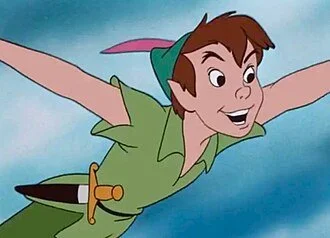
Walt Disney, Public domain, via Wikimedia Commons
When I was a kid, my favorite story was J.M. Barrie’s Peter Pan. I first discovered it when I was too little to read, watching the 1960 television production and listening over and over to the soundtrack of Disney’s 1953 movie. It really got into my head.
The story of Peter Pan juxtaposes Wendy Darling—a responsible young girl who shares a nursery with her two younger brothers in London—with Peter who, though he’s lived a long time, is still a boy…yeah. And he can fly. 😳 He lives in Neverland—a place that exists among the stars—where he can stay a boy forever.
Peter, along with a jealous and sometimes angry little pixie called Tinker Bell, flies to the window of the Darling nursery to listen to the bedtime stories Mrs. Darling tells her children. One night Nana, the Darling’s dog, catches Peter’s shadow, so Peter returns and slips into the nursery to get it back. How Jungian! 😊
When Peter finds his shadow, he tries to attach it to himself with soap, and when that doesn’t work, he begins to cry, waking up Wendy.
In describing their conversation, Barrie, as the narrator, says Peter speaks in a voice, “that no woman has ever yet been able to resist” (p.26). Wendy learns that he doesn’t have a mother, and suggests that that is why he’s crying—but he denies it. He’s only upset about the shadow. When Wendy sews it on for him, he immediately takes credit and shouts, “How clever I am!” The narrator follows up with, “It is humiliating to have to confess that this conceit of Peter was one of his most fascinating qualities” (p.25).

When Peter tells Wendy how much he loves her mother’s stories, Wendy boasts that she knows a lot of stories, too. So, he tries to persuade her to go with him to Neverland promising adventure—she’ll learn to fly (via pixie dust), meet mermaids—and, of course, take care of him and a group of motherless boys called the lost boys by darning their clothes, making pockets, and tucking them in at night. Oy. 🙄
Wendy agrees, Peter tosses some pixie dust, and off they go!
Right from the beginning of the story, Peter comes off as charismatic, immature, conceited, and manipulative. Wendy is caring, but haughty—which is why she seems to like the idea of playing mom to Peter and the lost boys. She plays this role well in Neverland, where they have all sorts of adventures involving characters such as pirates—led by Captain Hook—mermaids, and a crocodile that has swallowed both Captain Hook’s hand (which explains the hook) and a ticking clock that serves to signal when the crocodile is near.
Eventually, though, Peter takes Wendy and her brothers home to London, and he returns to Neverland to have more fun. Years later, he flies back to the nursery to retrieve Wendy, but when he realizes that she’s grown up, he takes her young daughter with him to Neverland instead.
Saint Wendy?
From the perspective of Jungian psychology, Peter represents the archetypal pattern of the puer aeternus, the “eternal boy,” who refuses to grow up. Fun and exciting, but when this pattern is lived unconsciously, its shadow expression can leave a person trapped in a world of fantasy and unlimited possibility, unable to make the commitments and accept the responsibilities of adult life.
Peter unconsciously longs for a mother. So, he projects onto Wendy an unconscious anima image—his own feminine that has not been integrated and that, in his case, takes a maternal form. Wendy becomes the carrier of this projection, and although only a child herself, takes care of him. Wendy constellates several archetypes: Mother, Maiden, and Caretaker.
As a child, I totally saw myself as Wendy. But I didn’t simply identify with her—I felt sorry for her. In my imagination, she was both a victim and a martyr, forced to leave the exciting world of Neverland, go back to her boring life in London, and miss out on all the fun and excitement. She even had to stay behind when Peter came back for her years later because, by then, she was too old to return.
I hadn’t simply identified with the Caretaker archetype. I’d identified with its shadow expression: martyrdom. I remember my dad coming to tuck me in one night when I was about four-years-old, only to find me sleeping at the very edge of my twin bed, squashed against the wall. When he asked why I wasn’t lying in the middle of the bed, I said it was because I had to leave room for Peter and the lost boys—and I imagined Tinker Bell at the edge of the pillow.
That image of me—very small and at the very edge of my bed—stays in my mind because it was the template for how I related to men throughout my life: taking very little room for me as I made space for and mothered eternal boys.
Had Peter Pan ended up running—and ruining—my life? 🥺
The devil is in the details
Thinking about the story, I decided to go back—as an adult—and read the book.
I was shocked to discover that Peter doesn’t “take” Wendy back to London. She chooses to return home instead of flying around Neverland forever in a cloud of pixie dust. As I said earlier, the details matter. I had—unconsciously—forgotten this one.
The turning point comes when Wendy tells Peter and the lost boys—who’d all run away from home—that mothers always leave nursery windows open for their children, so they can return. Peter, though, tells a story about a return trip to his home, where he found the window shut and another child sleeping in his bed. Wendy, afraid that her parents will forget them if they stay, insists that she and her brothers return home.
Wendy wasn’t a victim or martyr at all. She didn’t want to stay in Neverland. She didn’t want to be forgotten by her parents, who modeled adulthood. So, she chose to leave, chose reality over fantasy, and eventually became a mother herself. Symbolically, her choice represents a movement toward maturity and, from a Jungian perspective, individuation.
How the hell did I miss that??? 😳
Then it hit me. Barrie’s Wendy wasn’t a martyr. Mine was.
That was a revelation. And I hadn’t simply remembered the story incorrectly. My unconscious had rewritten it.
Stuck in a holding pattern
I flew around Neverland with a Peter Pan, too. For a while, it was exhilarating. So many adventures, so much excitement. But, ultimately, so much responsibility and so much ego-bolstering. I, too, ended up carrying a Peter Pan’s projected maternal anima, until the burden of it felt too heavy, and the relationship ended because I couldn’t carry it anymore.
But here’s the best part. Instead of going home and “growing up,” I found another Peter, got into the pixie dust again (which I’m thinking now should be a controlled substance 😉), took another aerial tour of Neverland, and carried another feminine projection until it was, again, too much. Unconsciously, I did this over and over again. The only difference was the person who played Peter in my story.
And since I saw Wendy as a martyr, I didn’t even consciously leave these relationships. Instead, I see now that I unconsciously stopped engaging in the behavior that supported the projection until the various men I was involved with stopped getting what they needed, and they would choose to end the relationship. Because martyrs don’t quit. Joan of Arc would have been proud.
One of my very early former boyfriends got sober a few years after we’d broken up and was doing “the steps.” When he got to Step 9, he came to see me and apologized, following up with, “But you should really ask yourself what you were doing with me.” So, sort of a backhanded apology. Not surprising. But he wasn’t wrong. I should have asked myself that question. I didn’t, though, because it was easier to be the martyr and put all of the blame on him. And so, the pattern continued.
Until I discovered that Wendy had made a conscious choice to leave Neverland. Then I finally did ask myself a question: Why didn’t I, like Wendy, choose to go home?
How to kick pixie dust
I can’t give you an easy answer.

I can’t even give you a single answer. It was a revelation to discover that my psyche had transformed Wendy into a martyr, and as I explore why, I am discovering a number of interconnected stories. Because no one’s life can be reduced to a single story—not even Peter Pan’s. But I’ll keep it simple here and focus only on the dynamics between the men I chose to be involved with and me.
The Caretaker archetype and its shadow—martyrdom—clearly had me in its possession. Both as a child and as an adult, I took on and successfully handled a lot of responsibility. Looking back, maybe more responsibility than was mine to carry. So, I often suppressed my carefree, playful, adventurous, and spontaneous side—banishing it into my Shadow. That story would explain the repeated partnering up with eternal boys as well as the acting out I did when I was unattached.
I played Wendy, the responsible grownup, even if, unconsciously, I wanted to be Peter, envying what he represented—the possibility of not always having to be the responsible one. What I didn’t realize was that I was seeing in him my own puer—the playful, adventurous part of myself that I’d never really allowed to develop as a conscious part of my personality, and which remained mostly suppressed and sometimes acted out.
In short, I needed someone carefree who could carry the projection of my shadow material—an image of the young, exciting, and adventurous masculine energy. I also needed someone who needed me enough to project a maternal anima image onto me, so the Caretaker pattern could be activated.
It was a match made in heaven. If heaven is Neverland. Because neither of us was doing the work of withdrawing, owning, and integrating our projections.
The irony is that I was looking for adventure and freedom and ended up with more responsibility. So, resentment wasn’t far behind. And not recognizing the part I played in this story kept the old “Wendy as victim and martyr” identity alive.
I’ve since found that seeing my own role and projections more clearly has allowed me to finally see the men I was involved with more clearly, too.
For sure, they presented an exciting and adventurous persona, and it seems that they were caught in the pattern of the puer aeternus—perfect projection holders for my suppressed shadow material. I wonder now if they felt the weight of my projection, in the same way that I felt the weight of theirs. Because no one can be exciting or adventurous all the time. And their need for someone who cared and who offered help—sometimes emotional, sometimes organizational, sometimes financial—fit in well with my martyr identity.
In short, they were just people, like me, living under the influence of unconscious patterns. And our patterns fed into each other.
Accepting these truths—among others—has not been easy. But it’s been incredibly freeing, despite the grief I feel over letting go of old identities and the years I spent hanging onto them.
And they lived happily ever after… (sort of)
Not out there in the world, though. Relationships that remain unconscious never end well. But internal unions are another story.
Over the past few years, I’ve been starting to own—not act out—that part of myself I’d projected onto various men. I’ve been traveling, learning and doing new things, and having adventures—but consciously—not with the frenzy that I felt when I was acting out. And I retired, which has freed up more than just my time.
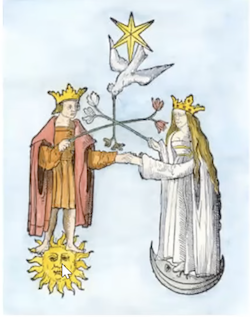
Rosarium Philosophorum via alchemywebsite.com
I’ve been finding a way to consciously balance responsibility and freedom within myself. As I withdraw my projections, I’m finding that they’re slowly loosening their grip, and the energy I’d invested in them is gradually becoming available for me to consciously live a more integrated life.
In my new story, Wendy and Peter have finally gotten married—the alchemical coniunctio, the union of opposites. I don’t completely understand this process, but it seems to be unfolding in its own time and isn’t something that can be forced. Better late than never, though!
Now Peter and Wendy need a house. I’m working on building it, but it’s going slowly, as most construction jobs do. The walls are temporary, the electricity goes out every now and then, and I’m still digging the basement—and falling into the pit more than a few times. Sometimes the pit I fall into is seeing myself, again, as a martyr; sometimes, when the “electricity” goes out, it’s my couch. But I manage not to stay in either pit for very long.
I’ve been surprised to discover that this place I’m building doesn’t feel boring—my biggest fear in life. And it’s spacious because it’s not constrained by the limitations of identifying with a single archetypal role. It has room for Wendy and Peter. It’s even got room for Tinker Bell—yeah, I’ve invited her, too. I want access to her jealousy and anger—you never know, I might be able to use them sometime. And better consciously than unconsciously! Despite the mess—and the occasional falls into the pit—I like it.
Here, though, I don’t get to be Joan of Arc. And while it may not have all the drama of Neverland, it’s also not a place that serves as a backdrop for a continuous loop of the same battles between Peter, who refuses to grow up, and Captain Hook, who’s haunted by the crocodile’s constant “tick-tock,” reminding him—and us—that we live in time. It’s a very ordinary place. I’m happy here.
Peter Pan was fun—at least for a while—and a great fall guy for a Wendy who was possessed and unconscious. So, maybe he didn’t ruin my life after all. Maybe my fascination with him was pointing me toward the part of myself that had been waiting to be lived consciously.
