
How can Tarot predict the future?
I first became interested in Tarot cards when I was in high school, before I ever heard of Jung. The deck I have now—a Rider-Waite deck—is the same one I had then. I always thought Tarot offered a way into some hidden knowledge—though I had no idea how it worked. At that time, it seemed otherworldly and magical—just what I needed to escape the angst of adolescence.
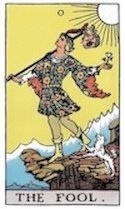
The deck came with a little booklet that I still have and that offers very short interpretations of each of the cards. It isn’t too helpful. The interpretations are as cryptic as some of the images on the cards. For the The Fool, in addition to folly, it says mania, intoxication and delirium. But when I look at The Fool card [1] I don’t get that at all. He looks free and happy. Though he does seem oblivious to the fact that he’s heading off of a cliff. So, maybe just folly.
The Fool reminds me of my 20s. At that time, a friend told me that I was like a person driving a car with the gas pedal to the floor—heading toward a cliff. But instead of braking, I keep going, thinking, “Well, this could be interesting.” He was right.
But so was I. Because what usually ended up happening was interesting. Exhilarating sometimes. Painful most times. But always interesting.
The booklet also says The Fool means bewrayment. MSWord didn’t recognize bewrayment. Neither did I, so I looked it up. It’s archaic and means to betray or reveal. I guess the trip off the cliff can feel like some sort of betrayal. Who gets betrayed? Ourselves? Someone else? And what can the adventure that follows stepping off a cliff reveal to a fool? A lesson about life? About themselves?
Back then, though, I didn’t yet have the life experience I needed to look past the booklet and trust my own sense of the meanings of the cards. So, I read them pretty superficially. But that was good enough for me.
When reading cards then, I asked all sorts of teenage yes/no questions: Does so-and-so like me? Should so-and-so and I break up? Would I have a career? Get married? Travel to Paris?
In other words, as a teenager, I read my cards to know the future.
Now I read them to know myself.
What’s the Jung-Tarot connection?
Getting to know myself is part of the psychological journey toward wholeness and self-realization that Jung called individuation. And I’ve found Tarot to be a great tool for facilitating that process, which involves accessing the unconscious to discover and integrate hidden parts of myself so I can live a more authentic life. So, now I read my cards from a Jungian perspective.
If you’re unfamiliar with the Tarot, it’s a deck of seventy-eight cards. Twenty-two of them, the Major Arcana, numbered zero to twenty-one, represent archetypes [2] such as Strength and Justice, and are beautifully illustrated. The remaining fifty-six are called the Minor Arcana and are very similar to a deck of regular playing cards—four suits containing cards numbered ace through ten, plus court cards. Unlike playing cards, though, Minor Arcana cards, at least since the 1900s, are usually illustrated with images of everyday situations and people.
Tarot cards have been around since at least the middle of the fifteenth century and were used in Italy for a game called Tarocchi. Despite what you might have heard, they didn’t originate in ancient Egypt. And they only started to be used for divination in the mid 1700s—in France. So, not so mystical, after all.
But the images are powerful—just look again at The Fool above. Jung would say the images are symbolic.
Jung believed that most of who we are exists beneath the level of consciousness, and he discovered that the unconscious reveals itself through symbols—such as dreams, imagination, and art. Symbols are psychic images that are not just visual, but experiential and allow the conscious and unconscious to enter into a living relationship with each other.[3]
Symbols, then, are small doors to the unknown and only partially knowable material of the unconscious. I sense this when I wake up, remembering a powerful dream—the feelings it evoked and even details of it. But can’t find the words to tell to someone exactly what happened in it. I find it’s the same with art. I don't know a lot about art and can’t talk about it very intelligently, but I’ve always appreciated its ability to move me deeply and to express something that I can’t explain—and that I’m not even sure I understand. [4]
So, Tarot cards facilitate individuation because the images on them are symbols that allow the unconscious to reveal its secrets. In fact, the word arcana means “secrets,” and Ken James, in his course A Jungian Perspective on the Tarot, suggests these are “secrets we keep from ourselves.”
The Major Arcana that are numbered one to twenty-one seem to offer what Sallie Nichols, in Jung and Tarot, calls a map for “a journey into our own depths” (p. 2). In other words, a map of the individuation process. And Rachel Pollack, in Seventy-Eight Degrees of Wisdom: A Tarot Journey to Self-Awareness, sees The Fool, numbered zero, as outside of the journey, "ready to leap into the archetypal world of the trumps” (p. 24). Though he looks like he’s ready to fall into it.
The journey through the trumps looks something like this, with midlife falling between lines two and three:
1. The Worldly Sequence: Developing an ego and becoming an adult in the conscious world.
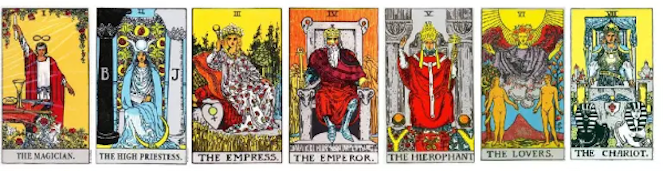
2. The Search for Self-Knowledge: Discovering who we really are by bringing what’s unconscious to consciousness.
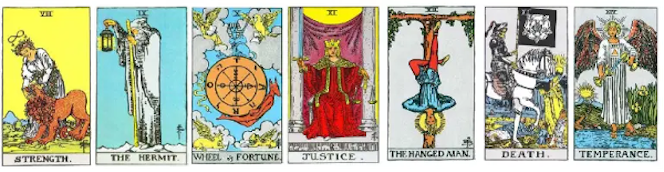
3. The Great Journey: Developing spiritual awareness and releasing archetypal energy by establishing a living relationship between the ego—the center of consciousness–and the Self—the center of the entire psyche.[5]
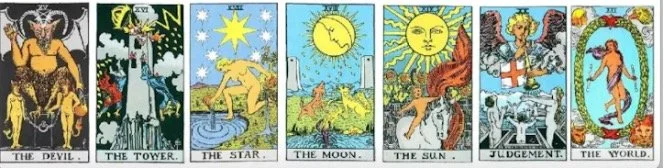
In short, the images of the trumps represent the path of individuation and serve as symbols to facilitate that process.
How?
When you work with Tarot, you need to remove the ego from the driver’s seat, or as James would say, relativize it. Once you’ve consciously asked the question, you choose cards sight-unseen, allowing the unconscious to reveal itself through the random selection of the cards.
You’re probably wondering how it can possibly be that when we randomly choose the cards, the cards align with the questions we ask. In other words, how can the random selection of cards, driven by a question, be meaningful?
Of course, the alignment between the cards and the question could simply be coincidence. Or maybe we just “read into” what we want to see in whichever cards come up. But my experience has been that something else is going on that goes beyond reductionist psychological explanations.
I read my cards regularly and have noticed that the same ones come up repeatedly—while there are others that I never draw. And, if something shifts for me, psychologically and/or materially (and they usually go hand-in-hand), a new repeating card starts showing up.
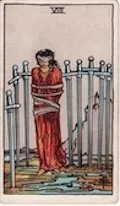
For example, during a period when I felt particularly stuck, I kept pulling the VIII of Swords. Notice that the woman looks stuck, but, being blindfolded, she doesn’t see that she can just walk away. There’s no one there to stop her, the ties are loose and don’t even bind her legs, and the swords don’t completely encircle her. So, what’s really holding her back? Her inability to see the situation clearly. Pollack calls this card a Gate card because it can lead to the awareness of our own ignorance—the first and hardest step to knowledge. This card helped me see that the oppression I was feeling was not coming from an external source, but from my own lack of clarity.
And sometimes the cards that come up don’t give the answer I was hoping for. (Note: It doesn’t “count” if you keep choosing cards till you get the answer you want. And unfortunately, it also doesn’t work. 😉)
I’ve also noticed that if you pull cards without asking a question, it’s often hard to make sense of the cards. So, asking the question seems to be important. Why?
Have you ever thought about someone and, at that moment, they call? Your thinking didn’t cause the call. And their calling didn’t cause your thought. But the two events—your inner thought and the external phone call—coincided in a meaningful way.
Jung developed his theory of synchronicity based on numerous observations of similar meaningful coincidences; his exploration of the connections between analytical psychology and quantum physics with physicist Wolfgang Pauli; and his investigation of oracles, such as the I Ching and Tarot. The theory of synchronicity suggests that a random draw of the Tarot cards can meaningfully coincide with the total psychic field—the constellation of what we are and aren’t aware of at a particular moment in time. The question we ask is needed to constellate the field. [6]
So, how can Tarot predict the future?
When I was a kid, I fooled around (there’s The Fool, again!) with Tarot because I wanted to know the future so I could escape the confusion and pain of adolescence. I needed to have some control during that transitional time, to see some light—that was not a train—at the end of the tunnel. Tarot made me feel mystical (kind of cool in the 70s—at least for a nerd like me), but it didn’t really help because I was using Tarot to try to predict a future that would happen to me—not one that would emerge from me.
The good news, for teenagers, is that the transitional period of adolescence ends. The bad news, for the rest of us, is that life—if you really live it to its fullest—is a series of transitions, each one bringing its own uncertainty and confusion. Because during transitions, you’ve got one foot in a world you know and the other in a world that you’re not yet sure of.
So, transitions, by nature, create uncertainty and confusion.
More good news, though. There’s a way to make transitions easier to navigate—at any age.
Transitions are calls to get to know yourself. All of yourself. The good, the bad, and the ugly. Not so you can change yourself, but so that you can change your life and live in a way that aligns with the most expansive version of who you are. But it starts with answering the call to get to know who you really are.
This involves asking deep questions, letting the conscious ego take a step back, and making space for the unconscious to reveal its answers through dreams, active imagination—or oracles like Tarot. And if you don’t know what questions to ask, you can always engage the help of a Jungian therapist or coach.
Reflect on the answers that come up. And if you’re using Tarot, remember not to keep choosing cards till you get one you like! Because this work requires radical honesty, acceptance, and integration. And it starts with becoming aware of the secrets the unconscious holds.
So, now when I read my Tarot cards, I ask questions such as, “What’s going on?” What’s the source of this? What do I need to be paying attention to?” What are some ways I can address this issue?
I don’t ask those yes/no, future oriented questions about what’s going to “happen” that I asked as a teenager. Well…maybe once in a while. 😉
In short, I no longer use Tarot to predict the future. Instead, I use Tarot as a small door to knowing myself. But I find that the more I know myself, the more I can “predict” my future.
[1] Card images are © Copyright U.S. Games Systems, Inc.
[2] Archetypes, in Jungian psychology, are the inherited, universal, energetic patterns of thought or behavior that reside in that part of the unconscious that Jung discovered we all share—the collective unconscious. Note: There isn’t, though, a one-to-one mapping between the Tarot Major Arcana cards and archetypes. Cards can represent more than one archetype, and archetypes can be represented by more than one card.
[3] Jung, in Psychological Types (1971 revision), defines a symbol as a product of the psyche that is “the best possible expression at the moment for a fact as yet unknown, or only relatively known…provided that we accept the expression as standing for something that is only divined and not yet clearly conscious” (par 817). He elaborates on this provision, stating that, “Whether a thing is a symbol or not depends chiefly on the attitude (q.v.) of the observing consciousness; for instance, on whether it regards a given fact not merely as such but also as an expression for something unknown” (par 818).
[4] Symbols highlight the limits of language. I remember in college taking a Philosophy of Language course where we needed to read Ludwig Wittgenstein’s Tractatus Logico-Philosophicus (1921). The title is a mouthful—a good indication of what reading the book is like! In it, Wittgenstein was talking about the limits of language and says we can only meaningfully talk about facts and the natural world. Wittgenstein says that the most important things in life (ethics, aesthetics, the meaning of life, and the existence of the world itself) cannot be expressed in a meaningful way, because these concepts are not empirical facts. They can only be shown. After slogging through the book, I came to the last sentence: “Whereof one cannot speak, thereof one must be silent,” and I was like, WTF? But I got it.
And in Hermann Hesse’s Journey to the East (1956), the narrator, H.H. says, “I agree with Siddhartha, our wise friend from the East, who once said: ‘Words do not express thoughts very well; everything immediately becomes a little different, a little distorted, a little foolish. And yet it also pleases me and seems right that what is of value and wisdom to one man seems nonsense to another’” (p.7).
[5] This relationship is not one of equals. Nichols describes the Self as transcending “the puny ‘I’ of ego awareness” and, as a result, the individual becomes aware that the “ego is merely a small planet revolving around a giant central sun—the Self” (p. 17).
[6] Jung defined synchronicity as an acausal relationship—a meaningful coincidence between the internal and external, where neither causes the other. In this theory, there are a few different views as to the actual mechanism that underlies synchronicity. Jung, himself, hypothesized, but didn’t fully commit to, a view where both the inner image (psyche) and outer event (the world) arise from the same underlying reality—the unus mundus, or one-world view. Jung says, “it is not only possible but fairly probable, even, that psyche and matter are two different aspects of one and the same thing” (Mysterium Coniunctionis Collected Works Volume 14, p. 537). This is the most radical and most metaphysical view. A more conservative, but still Jungian approach, says that the psyche projects onto the world so that coincidences feel meaningful. In this view, synchronicity becomes a mode of meaning-making and metaphysical claims are avoided. Sallie Nichols, in Jung and Tarot (1980), seems to take this view when she calls the Tarot trumps, “projection holders, meaning simply they are hooks to catch the imagination” (p. 9). If you’d like to know more about synchronicity, take a look at Jung’s Foreword to Richard Wilhelm’s I Ching, Marie-Louise von Franz’ On Divination and Synchronicity (1969), or Jung’s own Synchronicity (1960). Although Jung didn’t write extensively about Tarot, you can read what he wrote by checking out the Visions Seminars (1930-1934) and the Eranos Lectures (1933).
