
How could I have been such a fool?
“The Fool can burst unexpectedly into our personal lives with the result that, despite all conscious intentions, we end up playing the fool ourselves.”
Sallie Nichols, Jung and Tarot, (1980, p. 10).
For over a month, I was working on a post about looking at the Tarot from a Jungian perspective. Still haven’t finished it. As I kept researching and rewriting, it got longer and longer—too long for a blog post. I never felt satisfied with it, and I started having dreams about it—seriously? Finally, I got stuck. I really needed to find a way out, a small door—then I realized that struggling with writing the post was a small door.
Oh, what a fool I am.
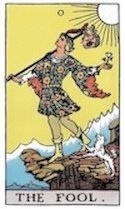
The Fool © Copyright U.S. Games Systems, Inc.
Ironically, the piece was meant as a follow-up to two previous posts that shared the common theme of getting comfortable with being a fool. And both included this image of The Fool from the Rider-Waite Tarot. In the new post, I wanted to talk about the Jung-Tarot connection and focus on the discomfort—but also the ubiquity, necessity, and freedom—of feeling like a fool.
That was it. That was all I wanted to say. But then I went down a some rabbit holes. As I tend to do.
First rabbit hole: Providing some background on Jungian psychology became, in my hands, more than I bargained for. Jung’s career spanned decades. His ideas evolved during his lifetime, and both theory and application continue to develop in contemporary “post-Jungian” work, which extends and often differs from Jung’s own writing. I wanted to be accurate and precise. So, I tried to explain it all. The early theory, the problems, and the developments. In a blog post, no less. Not happening. And probably not even interesting—in that kind of detail—to casual readers. Even I was starting to get bored… and I was writing it!
And then there was the Tarot. Again, quite a bit to talk about. It’s history and, among decks, differences in the images, ordering, and interpretations of the cards. Second rabbit hole. And again, my obsession with being precise and including everything was making it, well, just too much.
I was enjoying learning by going down the rabbit holes, but I was losing my excitement about writing that post. It was turning out to be a very different experience from writing the first few. Writing those was fun, but writing the follow-up was starting to feel, as we used to say in the 60s, like a drag. I felt like I was back in academia, where perfectionism driven by imposter syndrome is more prevalent than you might think, and where writing conventions can sometimes take a really interesting subject and turn it into Ambien. 😴
And then it hit me. In my earlier posts, I was writing from my experience, from a place of my own authority. It felt alive and exciting.
But in that still unfinished post, I was talking about other people’s work and writing, and I was being driven by an underlying fear of misrepresenting or missing something. Of being wrong. I was experiencing exactly what I was cautioning against in the earlier post, “What’s so wrong about being wrong?” Honestly, you can’t make this shit up. And I started laughing.
No wonder I was feeling stuck in writing that post. And then I realized I had also been feeling stuck, in general, because I was still hanging on to some previous and no longer viable identities. In the case of writing the post, the academic.
My dreams were pretty clear about it, too.
During this past month, many of my dreams were taking place on the block where I grew up and in restaurants where I worked when I was in my 20’s and early 30’s. Or in weird, unfamiliar places that I couldn’t pin down—like the dream where I was either in Alaska or Thailand. Somehow, the liminal space in my dream felt like both. Strange.
The dreams involved taking responsibility for roles that were no longer mine—waitress, wife, mom (not over, but very, very different), and instructor at the college I retired from. In one dream, I saw the word juncture written on the refrigerator in the kitchen of a former colleague—not too subtle!
There was a dream, though, where a woman showed up and pointed out a different perspective.
The woman was a former colleague, interestingly, named Grace. I asked her to read a paper that I had to grade, but had not yet read. Though I have no daughter in real life, in the dream, the paper was written by my “daughter”—a newer, unconscious part of me?
Grace skimmed the paper and I had the sense that in it, my “daughter” was complaining about something that had happened between her and me. Grace looked up from the paper and said, “Well, you know more about this incident than I do.” And I replied, “It’s not about the incident. It’s about how it was written.”
My take on that dream was that I was concerned about the performance— how my “daughter’s” paper was written—and I was missing the point that the only one who could possibly know if the content was accurate was me. And “my daughter,” of course. Could she have been complaining about me trying to turn a blog post into a research paper?
I was being a fool. Again. Because writing a research paper is part of a world where I had figured out how to perform and had achieved some success. A world where I felt not so much safe as comfortable—until I didn’t anymore. Until that world started feeling uncomfortable. And no longer alive.
Since I retired, though, I’ve found that what does feel alive is writing from my own experience. Less dependent on others; more authentically me.
But because it’s also new, it doesn’t feel very comfortable. Like I’m somewhere in Alaska-Thailand—a place of opposites. My life has changed, and the parts of myself that were running my old life need to take a step back to allow other parts to have a voice.
But some of these newly discovered parts seem to be in direct opposition to who I thought I was, and I don’t particularly like them. For example, the “selfish” part that’s demanding that I set boundaries, so the “nice” part won’t develop resentments—which I was also discovering. Oy. 🙄
The goal is not to let the new part take over, but to allow it to have a say in the choices we make—to at least consider its perspective. Then this new part can be integrated into who we are instead of being rejected and repressed. When we’re not used to considering that alternative perspective, though, choosing a new way of being is uncomfortable, and it’s easy to fall back on old, more comfortable ways of thinking and acting that support an idealized version of ourselves.
Recently, I was telling my therapist about how I felt compelled to jump in and do a favor I really didn’t want to do—and hadn’t even been asked to do. I decided not to feed into the compulsion, didn’t offer to do the “unasked for” favor…and felt guilty for days. I didn’t like feeling “selfish.” I tried to tell him how my decision made me feel about myself. Struggling to find the right adjective, I said, “Not offering to help made me feel so…so..” And he suggested, “Healthy?” And again, I had to laugh.
The writing made my stuckness salient. And the dreams showed me that it wasn’t just about writing like an academic when that wasn’t what was called for, but about who I was becoming. So, after that dream, I pushed the “research paper” aside and wrote this post instead. Because the experience of attempting to write the other post was the small door…and it showed me where I still needed to let go.
Maybe I’ll get back to that other piece in time, or salvage some of it. But only if I can make it fun. And give myself a little “grace.”
In the meantime, though, if you would like to know more about Jungian psychology, and prefer online materials, take a look at courses on the Jung Platform, or check out the work of George Elder. And if you are looking for some introductory material, see Scott Jeffrey's writing on this topic
If you prefer books, try C.J. Jung’s Man and His Symbols (1964), Edward F. Edinger’s Ego and Archetype (1992), Andrew Steven’s Jung: A Very Short Introduction (2001), or Murray Stein’s Jung’s Map of the Soul. And anything at all by James Hollis. He’s an amazing writer.
And if you’d like to know more about Tarot from a Jungian point of view, check out Jung and Tarot: An Archetypal Journey (1980) by Sallie Nichols, Rachel Pollack’s Seventy-Eight Degrees of Wisdom: A Tarot Journey to Self-Awareness (2019), or Ken James’ course on the Jung Platform, A Jungian Perspective on the Tarot.
And who knows? Maybe I’ll finally finish that other post!
